
Patient Safety Trends in 2026: The 3 Tailwinds Driving Patient Readiness

Patient safety depends on making critical care decisions with complete clinical context, yet too many patients still reach intersections of major care journeys, such as surgery or cancer care, with key clinical context still missing. Undocumented medications, overlooked devices, outside diagnoses, and fragmented specialist records create preventable risk at the moment care teams are expected to act with confidence. Complete patient readiness addresses that gap by ensuring the right information is available early enough to guide decisions, leading to improved quality of care and clinician satisfaction in delivering that care.
Think of a patient that arrives for a procedure and late in the process the team discovers they are taking a blood thinner that was never documented correctly, or that they have a pacemaker that wasn’t identified or tracked when planning the case. Suddenly the case becomes a scramble. The care team is forced to choose between delaying the case, or proceeding under less-than-ideal conditions, neither of which is a good setup for high quality care.
In another setting, a patient begins cancer treatment with a significant cardiac history that was scattered across outside records and never fully surfaced before therapy began. The treatment plan moves forward with a cardiotoxic chemotherapy, and that important piece of missing historical information directly drives harm to the patient when it is discovered too late or when the patient has a complication with treatment.
Unfortunately, patient readiness has been easier to describe than to deliver. Clinicians and patients often have an ideal patient journey in their heads, and become frustrated when that ideal isn’t achieved. Medical records are scattered and hidden across multiple EMRs and not accessible to care teams or patients. Healthcare reimbursement has incentivized “good enough” at high volume, instead of rewarding high quality personalized care. And meanwhile, patients continue to get sicker and more complicated.
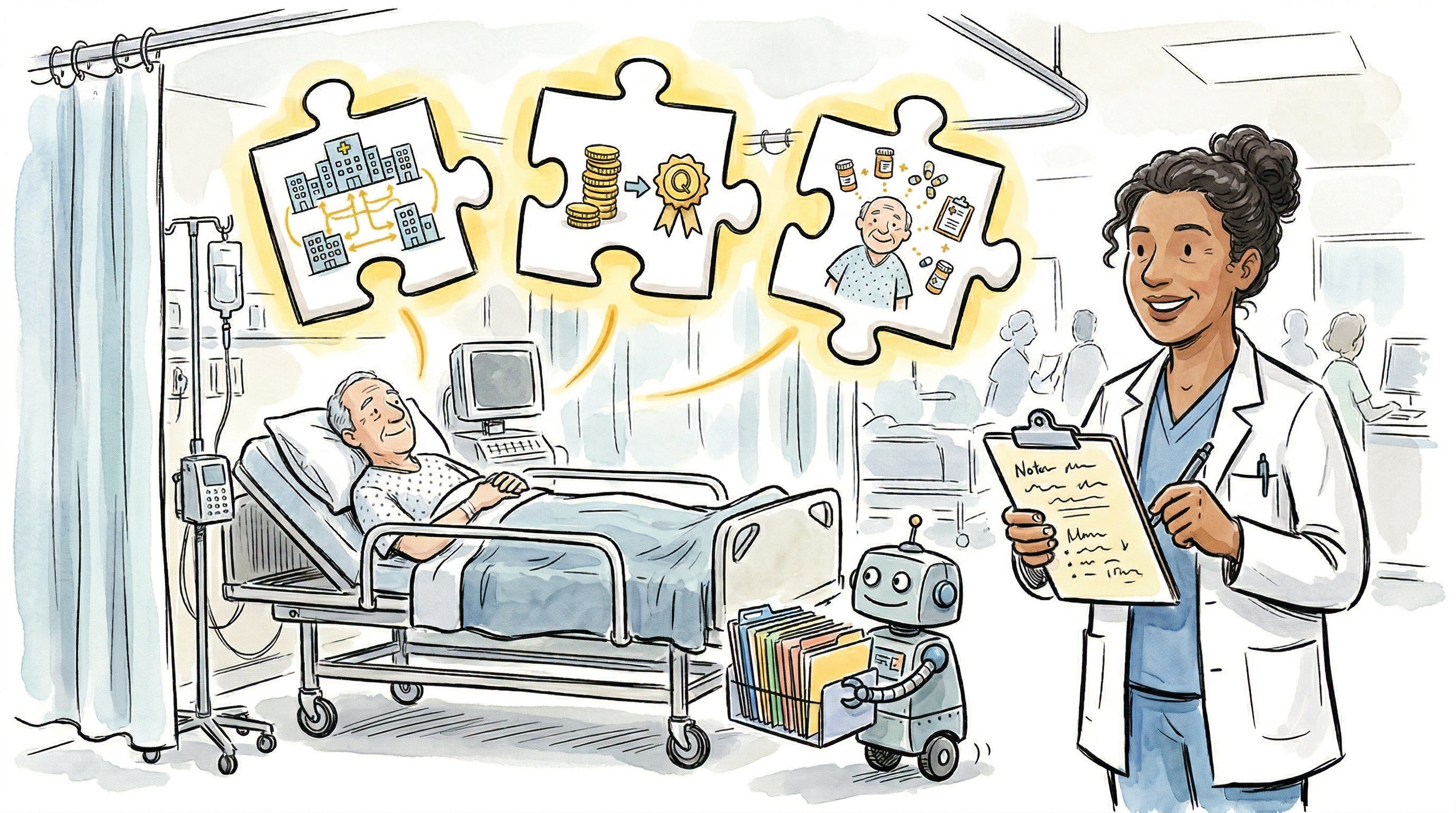
However, these three trends are now converging as tailwinds to make patient readiness a priority for the healthcare system to deliver more efficient, higher quality care.
1. The cost of generating accurate patient context is collapsing
The 21st Century Cures Act established TEFCA, a nationwide exchange framework now connecting more than 400 hospitals, 5,000 physician offices, and over 100,000 individual clinicians through a common agreement, while FHIR standardized the format for how that data moves between systems. The burgeoning focus on information blocking now makes it illegal for institutions to sit on data that should be accessible to the care team. None of this is perfect, and anyone who has tried to use an HIE tool as a side tab in an EMR to review outside records knows exactly how much work remains. But the foundation is now there in a way it simply was not five years ago.
This is where AI can enter the picture, with the ability to turn accessible data into usable clinical context at a speed and cost that no manual process can match. What previously required a trained and experienced clinician spending most of an afternoon assembling a preoperative picture from fragments, can now be generated in a fraction of that time, and often with better completeness. At Orchestra, we pull clinically relevant summaries from outside cardiology notes, specialist documentation, medication histories, and imaging reports across disconnected systems in seconds. The economic barrier that kept serious patient readiness work out of reach for most facilities is coming down, and it will keep coming down.
2. Payment models are beginning to reward knowing your patient before delivering care
Fee for service models in healthcare have had one major incentive structure, and meticulous patient readiness is not part of it. Fee for service rewards seeing as many patients as possible, regardless of the clinical status of the patient. Because of this, there is little to no reimbursement or revenue generated for triaging patients or covering the cost of thoroughly navigating records. This cost often ends up falling on a different part of the system than the one that generated the revenue from seeing the patient or booking the case.
That is continuing to change. The TEAM model launched at the start of this year, creating mandatory shared accountability between hospitals and surgeons for surgical episode outcomes across joint replacements, spine surgery and major bowel procedures. Meanwhile, procedures continue to come off the inpatient only list, moving into ASC and outpatient settings where margins are thinner and there is no hospital DRG to absorb the cost of a preventable complication or late cancellation. Finally, the recent ACCESS model is extending that logic further, by creating a canvas for outcome aligned payments of chronic conditions as opposed to surgery or acute conditions.
This shift will only continue, and patient readiness will be the key that unlocks margin in this environment. Capitated risk that isn’t identified can’t be managed.
3. The patients coming through the door are getting consistently more complicated
A 2024 study tracking 3.4 million hospitalizations over 15 years found that patients were 50% more likely to have multimorbidity, 82% more likely to be on polypharmacy, and twice as likely to require treatment for five or more acute medical issues compared to the beginning of the study period. A parallel analysis of 107 million hospital admissions in England found a 35% absolute increase in acute admissions among patients over 65 managing three or more chronic conditions, representing nearly a million additional complex hospital episodes annually compared to 15 years prior. In the United States, the prevalence of adults with two or more chronic conditions rose from 45.7% in 1988 to nearly 60% by 2014. Among adults over 65, multimorbidity prevalence is now approaching 92%.
Population aging explains some of this, but only some. Even after controlling for age and sex, the burden of extreme multimorbidity continues to climb. More patients, more medications, more specialists involved across more institutions, and more opportunities for something critical to fall through the cracks between those specialists before the patient lands in your preop area or clinic.
As the patient population gets more complex every year, the amount of time and reimbursement for the same visits and procedures is staying the same if not decreasing. The expectation that good clinical judgment in the moment will catch everything that matters is increasingly unrealistic. We can’t afford to keep doing things the same way in the face of this increasing medical complexity crunch.
Patient readiness is no longer optional
For health systems, patient readiness is a way to improve safety, reduce friction, and better match resources to patient need. For payers, it is a way to identify risk earlier, avoid preventable downstream utilization, and support more appropriate care navigation. For clinicians, it is a way to spend less time assembling the chart by tasks that are well below their level of license and spend more time making decisions that require their training.
Healthcare has talked for a long time about getting the right patient to the right care, in the right place, at the right time. Patient readiness is that operational layer that will make it possible.